HAZE
VADS CORNER — Haze, Smoke, Fire, API, PSI · Malaysia, Indonesia, Singapore, Brunei
Online since 22 September 1997 · Comprehensively revised 26 August 2026 · Last updated 5 September 2026
This site was set up during the 1997 haze in Indonesia, Malaysia, Singapore, Brunei and the surrounding region, caused by forest and peatland fires in Kalimantan and Sumatra. Readers asked for it after the enterovirus outbreak page earlier that year; it went up on 22 September 1997 and took fourteen thousand hits in three weeks. It has been updated at intervals ever since. It will be updated from time to time and retained as a reminder to us, as to what can go wrong if we are not careful.
NEW added in this revision FIXED URL corrected or source replaced ARCHIVE link dead, retained for the record VERIFY could not be confirmed — check before relying on it
Breathing Space — what to do about the haze
If you are not a clinician and simply want to know how to protect your household during an episode — which mask works, what to do indoors, who is most at risk, when to see a doctor — that is on one printable page.
Search the news
Quick links to current coverage of Haze across the key English-language newspapers in the region.
Malaysia
| Newspaper | Search Link |
|---|---|
| New Straits Times | NST – Haze |
| Malay Mail | Malay Mail – Haze |
| The Star | The Star – Haze |
| Borneo Post | Borneo Post – Haze |
Singapore
| Newspaper | Search Link |
|---|---|
| The Straits Times | Straits Times – Haze |
| CNA | CNA – Haze |
Indonesia
| Newspaper | Search Link |
|---|---|
| Jakarta Post | Jakarta Post – Haze |
Live monitoring — start here
Malaysia
- APIMS — Air Pollutant Index Management System FIXED — now on the MyEQMS platform; the legacy apims.doe.gov.my address is retired. Real-time API by station, free and without registration, updated hourly. The same data is carried by the MyJAS EQMS mobile app, which replaced the older MyIPU app. Band detail under Air quality index, country by country below.
- Department of Environment FIXED — see also the press statement archive NEW, which carried near-daily haze status bulletins during the July 2025 episode.
- MetMalaysia FIXED — monsoon onset announcements, heatwave alerts and forecasts.
- Ministry of Health Malaysia NEW
- iDengue NEW — MOH and the Malaysian Space Agency. Included because dry-season fire years and dengue years travel together.
Regional — ASEAN
- ASEAN Specialised Meteorological Centre (ASMC) NEW — the designated regional haze monitoring body since 1993, hosted by the Meteorological Service Singapore. This should now be the first place you look, and it was missing from this page for twenty years.
- Alert levels and early warnings
- Hotspot distribution and counts — direct link to the live hotspot heatmap
- GIS portal — hotspots, rainfall and peatland layers
- WIS 2.0 portal — 24-hour surface PM10 prediction
- ASEAN Haze Portal FIXED — replaces haze.asean.org. Agreement text and the Second Haze-Free Roadmap 2023–2030.
- ASEAN Fire Alert NEW
Air quality index, country by country NEW
- Malaysia — API. APIMS, Department of Environment. Carbon monoxide, ozone, nitrogen dioxide and sulphur dioxide reported in ppmv, with PM2.5 in µg/m³. Above 500, a state of emergency is declared in the reporting area: non-essential government services are suspended and ports closed.
- Singapore — PSI. Haze information and PSI, Meteorological Service Singapore FIXED — replaces the old haze.gov.sg microsite. See also the National Environment Agency.
- Indonesia — ISPU. ISPU, Ministry of Environment and Forestry NEW — seven pollutants (PM2.5, PM10, NO2, SO2, CO, O3 and hydrocarbon) across 72 stations, under Ministerial Regulation 14 of 2020. Bands: 0–50 baik (good), 51–100 sedang (moderate), 101–200 tidak sehat (unhealthy), 201–300 sangat tidak sehat (very unhealthy), above 300 berbahaya (hazardous). The domain has appeared under two names —
ispu.menlhk.go.idandispu.kemenlh.go.id; if one fails, try the other, or use the ISPU Net app on Android or iOS. Note the non-comparability with Malaysia’s API: both share band structure, but not the same pollutant weightings or averaging periods. - Thailand — AQI. Pollution Control Department FIXED
- Brunei, Philippines, Vietnam and the rest of ASEAN. I have not verified current official portals for these. Use the aggregators below, or the ASMC regional picture above. If you know a working government link, please send it.
Forecasting the smoke, not just measuring it NEW
- BMKG — Informasi Kualitas Udara Indonesia NEW — the most useful page on this site for anyone downwind. Six services in one place, all updated daily at 08:00 WIB:
- Extreme air quality early warning — three-day PM2.5 forecast for Indonesia, flagging unhealthy, very unhealthy and hazardous conditions by province.
- Haze dispersion forecast — three-day prediction of smoke particulate spread using Aerosol Optical Depth at 550 nm, specific to biomass burning. Source-region forecasting, which is what Malaysia lacks.
- Numerical pollutant dispersion model — air quality conditions influenced by concentration, temperature, humidity and wind.
- Near-real-time PM2.5 monitoring — from BMKG’s national network, with seven-day history.
- Daily satellite hotspot monitoring — count and location of active fire detections across Indonesia, with archived data.
- Fire potential prediction — monthly forecast of forest and land fire risk at low, moderate and high levels, covering up to seven months ahead.
- ASMC WIS 2.0 — 24-hour surface PM10 prediction across the ASEAN region.
Seasonal outlook
- SIIA Haze Outlook NEW — the Singapore Institute of International Affairs has published an annual regional haze risk assessment since 2019, rated green, amber or red. The 2026 edition went red in June and named August and September as the peak danger period. Worth watching each June.
Independent aggregators — for cross-border comparison
- World Air Quality Index NEW — normalises national data onto one scale. The practical way to compare across borders, and the fallback for ASEAN countries whose own portals are not listed above.
- IQAir — Malaysia NEW — source of the "most polluted city" rankings that appear in the press.
- AirNow — United States, and a useful model for how advisories can be presented.
Indonesian fire and peatland monitoring
- Nusantara Atlas NEW — independent forest and fire monitoring; burned-area figures.
- Pantau Gambut NEW — peatland monitoring, including hotspots inside concession areas.
Satellite and global fire monitoring
- NASA FIRMS — near-real-time active fire detection. Still the clearest answer to anyone who says the source of the smoke is uncertain.
- NASA Earthdata FIRMS FIXED
- Global Fire Monitoring Center — current significant global fire events. (Thanks to John D Anderson, who supplied these links originally.)
- Regional Fire Management Resource Center — South East Asia
- NASA Earth Observatory — Fires FIXED
- CRISP FIXED — Centre for Remote Imaging, Sensing and Processing, National University of Singapore. Satellite imagery of the region; the source of many of the fire and smoke images used during the 1997–98 episodes.
- Copernicus Atmosphere Monitoring Service NEW
- Copernicus Climate Change Service NEW — monthly global climate bulletins; the source of the "warmest month on record" headlines.
- Global Forest Watch — Fires NEW
Health effects of haze
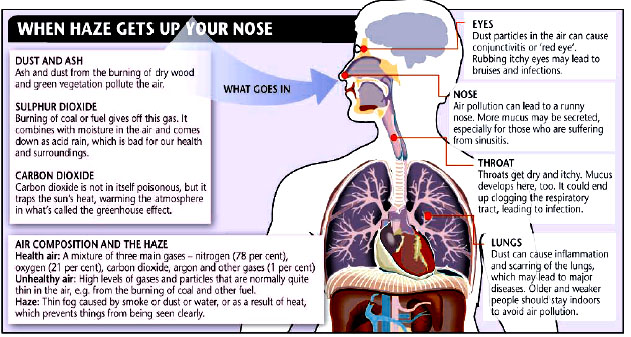
Advice and protection
- Precautions to be taken — on this site. Due for review against current guidance.
- How to wear a face mask — on this site since 1997, and now out of date. It predates the general public use of N95 respirators. Use the sources immediately below instead; this page is retained for the record and is due for rewriting.
- WHO — wildfires and health NEW
- US CDC — wildfire smoke and health NEW
- US EPA — DIY air cleaners for wildfire smoke NEW — a box fan and a filter. Cheap, well-evidenced, and badly under-promoted in this region.
- MOH Clinical Guidelines on Management of Heat Related Illness (2016, PDF) NEW — our own guidance, hosted on the Global Heat Health Information Network site.
- Ministry of Health — Jerebu (Haze) NEW — the Ministry's own standing haze page, under Health Information. This is where the Director-General's statements on haze-related illness are collected, and it is the current source that should be consulted first.
- MOH public information leaflet (PDF) — on this site. A scan of the printed leaflet from an earlier episode; retained as a record of what the public advice looked like at the time. Check the Ministry page above for anything current.
- Haze advice (PDF) — on this site, same vintage and the same caveat.
What the API figures mean
API bands: 0–50 good · 51–100 moderate · 101–200 unhealthy · 201–300 very unhealthy · 301–500 hazardous · above 500 emergency — at which point non-essential government services are suspended and ports in the affected area closed.

Masks and respirators — current guidance NEW
The short version: only a well-fitted N95 or P100 helps. Surgical masks, cloth masks, single-strap dust masks and bandanas do not filter fine particulate. Fit matters more than the rating — a good respirator with a gap at the nose bridge leaks more air than it filters. No mask protects against the gases in smoke, only the particles. And staying indoors remains more effective than any mask.
- US EPA — Protect yourself from wildfire smoke and ash NEW — the clearest public-facing page. Choose a respirator with two straps that seals over the nose and under the chin, and check the seal per the package instructions. If you become dizzy, breathless or develop facial discomfort or headache while wearing one, go somewhere with cleaner air and remove it.
- Protect Your Lungs from Wildfire Smoke or Ash (PDF, June 2026) NEW — a one-page EPA factsheet with the fitting illustration. The one to print for a clinic waiting room.
- Washington State Department of Health — Protect yourself and others FIXED — the most practical on the awkward questions. N95s filter fine particles but not gases such as carbon monoxide; beards and facial hair prevent a proper seal; adult small N95s will likely fit children aged seven and over, and smaller sizes are not made. Includes a fitting video.
- CDC — Identifying NIOSH Approved respirators FIXED — replaces the retired cdc.gov/niosh/npptl/topics/respirators/disp_part/ pages. How to read the markings and tell an approved respirator from a counterfeit: manufacturer name, part number, filter series, and a TC approval number in the form TC-84A-XXXX.
- NIOSH Certified Equipment List NEW — searchable. Enter the TC number printed on the respirator and confirm it is what it claims to be.
- US EPA — Wildfires and indoor air quality NEW — what to do indoors, which matters more than the mask: windows and doors closed, fans and air conditioning to stay cool, and airing the house whenever the air improves, even briefly.
- US EPA — DIY air cleaners for wildfire smoke — a box fan and a filter. Cheap, well-evidenced, and badly under-promoted in this region.
Air quality standards
- New Malaysia Ambient Air Quality Standard NEW — PM2.5 at 35 µg/m³ over 24 hours and 15 µg/m³ annually, fully in force since 2020. Note that SUHAKAM records this as policy guidance with no legal basis; Malaysian law regulates industrial point sources, not ambient air.
- WHO Global Air Quality Guidelines 2021 NEW — PM2.5 at 15 µg/m³ over 24 hours and 5 µg/m³ annually. Our annual figure sits at WHO interim target 3.
- US EPA — criteria air pollutants FIXED · particulate matter · NAAQS
- UK Air Information Resource FIXED
- European Environment Agency — air pollution FIXED
Peer-reviewed evidence NEW SECTION
This page carried MEDLINE search links for twenty years but almost no actual papers. These are the studies worth reading, all open access unless noted. Fuller notes on each in HAZE-OC II.
Smoke haze
- A scoping review on the health effects of smoke haze from vegetation and peatland fires in Southeast Asia
Phung VLH et al. PLOS ONE 2022;17(9):e0274433. Explains why published mortality estimates range from about 1,064 to 260,000. Read this before quoting any haze death toll. - The health impacts of Indonesian peatland fires
Environmental Health 2022;21:62. Peat smoke as a chronic annual exposure — roughly 33,100 adult and 2,900 infant premature deaths a year. The finding that reframes the problem. - Public health impacts of the severe haze in Equatorial Asia in September–October 2015
Koplitz SN et al. Environmental Research Letters 2016;11:094023. The benchmark modelling study for 2015. - Association between PM10 and respiratory disease admissions in Peninsular Malaysia during haze
Scientific Reports 2024;14. 92 government hospitals, 2000–2019. The best domestic reference for a talk or a letter. - Acute health impacts of the Southeast Asian transboundary haze problem — a review
Cheong KH et al. Int J Environ Res Public Health 2019;16(18):3286. The clearest summary of the acute clinical picture. - Long-term exposure to particulate matter and mortality in the Asia-Pacific NEW
J Korean Med Sci 2025;40:e156. Per 10 µg/m³ PM2.5: all-cause mortality RR 1.11, cardiovascular 1.13, stroke 1.12. Useful for turning an API reading into something a patient understands. - Smoke haze and child health in Southeast Asia: Palembang, Indonesia NEW
Annals of Global Health 2026. 366,632 childhood ARI cases and 27,574 pneumonia cases over a decade in a city subject to annual peat fires. - Early Childhood during Indonesia's Wildfires: Health Outcomes and Long-Run Schooling Achievements NEW
Lo Bue MC. Economic Development and Cultural Change 2019;67(4):969–1003. Free full text. Exposure at 12–36 months during the 1997 fires cost about 0.9 SD in height-for-age, and that deficit predicted fewer completed grades of schooling. Note carefully: it does not find a significant effect on cognitive test scores, though several secondary summaries report one.
Climate and health
- The Lancet Countdown on health and climate change NEW — the annual global stocktake. There is also a Malaysia policy brief, little circulated among Malaysian doctors.
- WHO — Climate change and health NEW — including the operational framework for climate-resilient health systems.
- ClimaHealth NEW — the joint WHO–WMO climate and health portal.
- Global Heat Health Information Network NEW — heat action plan templates and clinical guidance.
- IPCC NEW — the Summary for Policymakers and the Asia regional fact sheet are an evening's reading.
- PubMed FIXED — replaces the old NCBI Entrez query links. Try haze health Southeast Asia, peatland fire mortality, or biomass smoke cardiovascular.
Agreements, policy and accountability NEW SECTION
- ASEAN Agreement on Transboundary Haze Pollution FIXED — signed in Kuala Lumpur on 10 June 2002, in force November 2003. Malaysia ratified first; Indonesia last, in 2014. Article 3 places a responsibility on states not to harm others' environment or health, but the Agreement carries no enforcement or dispute resolution mechanism. In twenty-three years no state has brought a claim against another.
- ASEAN Coordinating Centre for Transboundary Haze Pollution Control (ACCTHPC) NEW — its Jakarta office finally opened on 22 April 2026, a decade after Indonesia was designated to host it.
- ASEAN Environment FIXED — replaces the defunct aseansec.org pages.
- Silent Enemy: Report on Haze Pollution and the Right to Clean Air (PDF) NEW — SUHAKAM, 24 September 2024. The Commission's first environmental report, from a complaint by the CERAH Coalition. If you read one thing on this subject, read this. Index at suhakam.org.my/publications.
- NRES NEW — the Ministry, including its consultation paper on the National Climate Change Bill.
- Malaysian Bar — on the shelved Transboundary Haze Pollution Act NEW — drafted 2018, tabled 2019, shelved August 2020 on evidentiary grounds.
- CSIS — Examining transboundary haze in Southeast Asia NEW — notes that Malaysia's draft, unlike Singapore's 2014 Act, would have reached only domestic firms.
- Greenpeace Malaysia — ASEAN Haze Trauma report NEW — source for the 2019 sealing of 62 companies, of which six were Malaysian and nine Singaporean.
- Climate Change Laws of the World — Malaysia NEW — Grantham Institute database.
- Eco-Business NEW — the most consistent English-language reporting on regional haze and climate policy.
- Mongabay NEW — on-the-ground reporting from Indonesian fire provinces.
My own writing on the haze
Seven Cybermed columns in Berita MMA, and the piece that succeeds them.
- Hazedous — Vol.27 No.10, October 1997
- Review — Vol.28 No.2, February 1998
- Enterovirus, Haze, Nipah and Dioxin. What's Next? — Vol.29 No.6, June 1999
- Clouding the Issue — Vol.29 No.8, August 1999
- A.P.I : Time to put it out! — Vol.34 No.6, June 2004
- Release AP-I………Dr. m — Vol.35 No.7, July 2005
- HAZE-OC — Vol.36 No.9, September 2006
- HAZE-OC II — Kerbside Consult 1/2026 NEW
- Breathing Space — Kerbside Consult 2/2026 NEW. What to do about the haze: masks, indoor air, who is at risk, when to see a doctor. Plain and printable — start here if you are not a clinician.
- The Data Is There. They Just Won’t Show It. — Kerbside Consult 10/2026 NEW. Malaysia measures PM2.5 hourly at 68 stations. It does not publish the raw concentration. This piece explains what that gap costs clinically, and why the API alone is not enough during a haze episode.
Also on this site, and quoted at length in A.P.I : Time to put it out!: Haze: Are we hazy about the facts, written by Dr Rampal. Full column index at Cybermed; current writing at Kerbside Consult.
Related pages
- Fire, Smoke and Haze — the global companion page (wildfires in the US, Russia, Amazon, Greece, Canada, Australia). Online since 22 September 1997; largely of historical interest now.
- Malaysian Medical Association FIXED
Still live from 1999 NEW
One BBC page from that era survives, and it is worth keeping for a reason beyond nostalgia.
- BBC News — Flashback to Haze '98 NEW — published 2 August 1999, part of the BBC's Haze '98 special report. Its Internet links panel lists six sites: Indonesia Online, Haze links (this page, then at its GeoCities address), Asean Haze Action online, International Forest Fire News, the US Environmental Protection Agency and the Rainforest Action Network. Most of that list was institutional. Two days after it was published, a reader in Singapore arrived here from the BBC and signed the guestbook to suggest I get a proper domain.
Archive — dead links retained for the record

The links below no longer resolve. They are kept because they document how the 1997–2006 episodes were reported at the time, and because the disappearance of a decade of news coverage is itself worth noticing. Original URLs are shown but not linked. Some may be recoverable through the Internet Archive Wayback Machine.
GeoCities pages ARCHIVE
Yahoo closed GeoCities in 2009. Every geocities.com link on this site is dead, including the original 1997 haze page. Local replacements exist at ohs.html, search.html and disclaim.html.
geocities.com/vadivale/haze.html — the original 1997 haze page
geocities.com/HotSprings/2188/disclaim.html
geocities.com/HotSprings/2188/medsea.html
geocities.com/Athens/Oracle/8751/smoke/index.html — Central American smoke, thanks to Forrest M. Mims III
geocities.com/manipalalumni/haze.html — the 1997 mirror site
ASEAN ministerial statements, 1998–2002 ARCHIVE
The old aseansec.org domain was retired. Current material is at environment.asean.org.
Press Release, 9th ASEAN Ministerial Meeting on Haze, Kuala Lumpur, 11 June 2002
Joint Statement to the World Summit on Sustainable Development, Bali, 4 June 2002
Joint Press Statement, 8th ASEAN Ministerial Meeting on Environment, 6–7 October 2000
Kota Kinabalu Resolution on the Environment, 7 October 2000
Special Report on Forest Fire and Haze Situation in Indonesia, 2000
Joint Press Statement, 8th ASEAN Ministerial Meeting on Haze, 26 August 1999
ASEAN Responds to the Haze Situation, 13 August 1999
ASEAN Intensifies Monitoring of the Haze in the Region, 5 August 1999
Joint Press Statement, 7th ASEAN Ministerial Meeting on Haze, 6 July 1999
Joint Press Statement, 6th ASEAN Ministerial Meeting on Haze, 16 April 1999
Joint Press Statement, 5th ASEAN Ministerial Meeting on Haze, 30 July 1998
Third ASEAN Ministerial Meeting on Haze, 4 April 1998
ReliefWeb situation reports, 1997–2000 ARCHIVE
ReliefWeb rebuilt its site; the old Lotus Notes .nsf URLs are gone. Much of this material is still findable by title at reliefweb.int.
Indonesia Environmental Emergency — OCHA Situation Reports 5 to 10 (October 1997 – May 1998)
Land, Bush and Forest Fires — UNDAC Mission Report, 20 April 1998
UNEP short-term action plan to contain forest fires in Indonesia, 21 April 1998
A multi-billion estimate on the cost of Asia's forest fires — ABC, 29 May 1998
Indonesia: Haze/Smog — IFRC, 15 July 1998
Indonesian forest fires enter 'dangerous category' — AFP, 30 April 1999
Indonesia Forest Fires — OCHA Situation Report No. 1, 14 March 2000
Update on fire and haze situation in the region — ASEAN, 13 July 2000
News coverage, 1998–2005 ARCHIVE
Yahoo retired its news archive; the Straits Times, The Star and NST rebuilt their sites and dropped the old article paths; Planet Ark's CFM URLs are gone. Headlines are kept because together they are a record of how the story was told.
BBC — Malaysia haze triggers emergency (11 Aug 2005) · In pictures: Malaysia haze (11 Aug 2005) · Deadly Asian haze 'can be tamed' (12 Aug 2002) · Asian haze poses 'widespread threat' (11 Aug 2002) · Asia joins forces against haze (10 Jun 2002) · Smog fears grow across SE Asia (10 Jul 2001) · Smog smothers Malaysia (16 Jul 2000) · Indonesia gets tough over fires (13 Mar 2000) · Indonesia's fires: Who's to blame? (10 Mar 2000) · Air pollution stops rain (10 Mar 2000) · Sumatra fires 'national disaster' (8 Mar 2000) · Row over Malaysian haze (6 Aug 1999) · Sumatra haze 'as bad as 1997' (6 Aug 1999) · Malaysian government under fire over haze (6 Aug 1999) · Haze threatens SE Asian Games (4 Aug 1999) · Return of the Asian haze (1 Aug 1999) · The economic cost of the haze (7 Apr 1998) · Haze — bad for the health (8 Mar 1998) · Haze — what can be done (26 Feb 1998) · Haze — who starts the fires (25 Feb 1998) · Borneo ablaze (20 Feb 1998)
The Straits Times — Slight haze expected this week (13 Sep 2000) · Pilots complain about fires near KL airport (22 Jul 2000) · Sumatra fires bring back the haze (20 Jul 2000) · Minister defends ban on pollution readings (19 Jul 2000) · Weak laws and corruption fuel forest burning (18 Jul 2000) · Jakarta has no plan to combat forest fires (18 Jul 2000) · Haze shrouds half of Malaysia (17 Jul 2000) · Angry calls to make public air pollution index (17 Jul 2000) · Riau fires: Culprits found, but action unlikely (11 Mar 2000) · Simon Tay: What pressure can be put on Jakarta govt (10 Mar 2000) · Tracking down fire starters, one by one (9 Mar 2000)
The Star — Public to get only morning API (21 Jul 2000) · Cabinet discusses API request (20 Jul 2000) · No API readings to avoid distortions (19 Jul 2000) · Schools may protect students from the haze (18 Jul 2000) · Keep public in the know about haze condition (18 Jul 2000) · Plantation owners come under fire (10 Mar 2000) · Jakarta: Fires a national disaster (9 Mar 2000)
Planet Ark / Reuters — Hazy Malaysia keeps air quality data under wraps (11 Jul 2001) · Smog disperses in Malaysia, health concerns linger (18 Jul 2000) · Indonesia warns planters to end fires or face jail (15 Mar 2000) · Experts call for Jakarta to face court over smog (9 Aug 1999) · ASEAN urged to fight the smog or choke on it (2 Aug 1999) · Malaysia denounced for scrapping smog index (18 Jun 1999) · Malaysia withholds smog index numbers from public (15 Jun 1999)
Other — Sarawak Tribune, Borneo Bulletin, Asiaweek, CNET Asia, Christian Science Monitor, Far Eastern Economic Review and NST Interactive links from 1998–2005. jaring.my, asia1.com.sg, nstpi.com.my, pathfinder.com/asiaweek — all retired.
Note the recurring theme of the 1999–2001 headlines: the withholding of the API. SUHAKAM later recorded that the Official Secrets Act 1972 was used to withhold air pollution information, and that the API was treated as a state secret during the 1997 and 2005 crises. The index has been published continuously since; that remains the one unambiguous gain of the last two decades. This is the subject of the closing section of HAZE-OC II.
Retired agency and satellite services ARCHIVE

toms.gsfc.nasa.gov — Total Ozone Mapping Spectrometer aerosol index. Instrument retired; superseded by NASA Ozone Watch and Copernicus CAMS.
modarch.gsfc.nasa.gov/fire_atlas/ — MODIS Global Fire Atlas. Superseded by FIRMS.
rapidfire.sci.gsfc.nasa.gov/firemaps/ — MODIS Rapid Response. Superseded by FIRMS.
fs.fed.us/eng/indofire/ — USDA Forest Service Indonesian Fire Maps.
grid.unep.ch — UNEP GRID Geneva fire monitoring.
nectec.or.th/haze/ — Thailand haze information.
concord.org/haze/ — Haze Span, by Forrest M. Mims III.
deja.com — Usenet search, absorbed into Google Groups.
airquality.co.uk/archive/ — UK National Air Quality Archive, replaced by uk-air.defra.gov.uk.
who.dk — WHO Regional Office for Europe, now who.int/europe.
The Ilyushin-76 waterbomber correspondence, 1998–2002 ARCHIVE
A long exchange, mostly with John D Anderson and Stuart B Dobson, about whether the world's largest waterbomber was being unreasonably ignored by Western fire authorities. Nearly all external links are dead; the locally hosted documents survive.


Still on this site: Opinion: World's Best Fire-Fighting Plane Ignored · Catherine Ford, Canadian opinion-shaper · Russia So Far Denied Invitation to Centre Stage in Environmental Defence · Media statement from Australia's Planet Ark · A reader responds · Common Misconceptions… (PDF) · Press Release 2001/1 (PDF) VERIFY
Dead: waterbomber.com · go.to/waterbomber · members.xoom.com/cmm20/Ilyushin-76.mpg · didyouknow.com/firefighters.htm · ABC News, Christian Science Monitor, WorldNetDaily and Air Safety Week articles · gazeta.ru/rus_rescue.shtml
Ilyushin Il-76 — Wikipedia survives as a reference.
Haze in the Wind ARCHIVE
A parody lyric contributed by a reader named Joshua during the 1997–98 episode, sung to a well-known tune. It has been on this page since 1997. The full text has been removed in this revision on copyright grounds — it is a parody of a copyrighted song — but the contribution is recorded here with thanks.
The 1997 haze survey ARCHIVE
A week after this page went up I was asked to help run a survey on the haze; 115 people responded, from this region and from Australia and the United States. It was, as I wrote at the time, a challenge to build something like that on the web in 1997. The questionnaire is still here, and no longer collecting replies.
Winner of the Top 5 of CARI Awards, January 1998.

Content current as at 28 August 2026. Links last checked 28 August 2026.
Suggestions and corrections are welcome by email. Links were checked on 26 August 2026; those marked VERIFY could not be confirmed and should be tested before you rely on them. As always, some news links are retained though dead, as a reminder of the events that took place.